Gaspard Giroud : Comment fonctionne la 3D en temps réel ?

[kif_post_tags]

Gaspard Giroud : Je voulais qu’on parle un tout petit peu de technique pour comprendre vraiment quelle est la différence entre une simulation sur un moteur de jeu par rapport aux médias traditionnels qu’on connaît en 2D ?

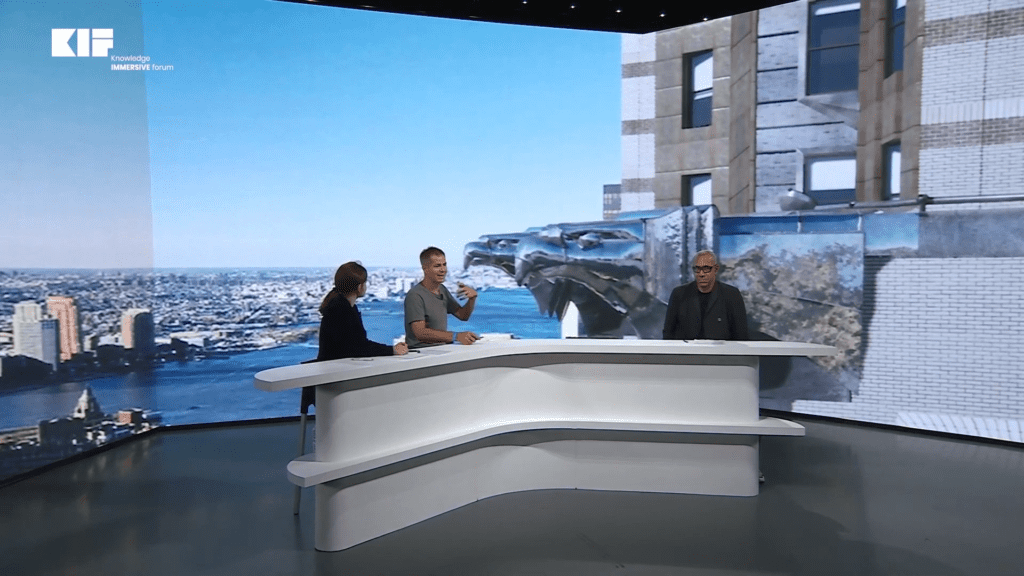
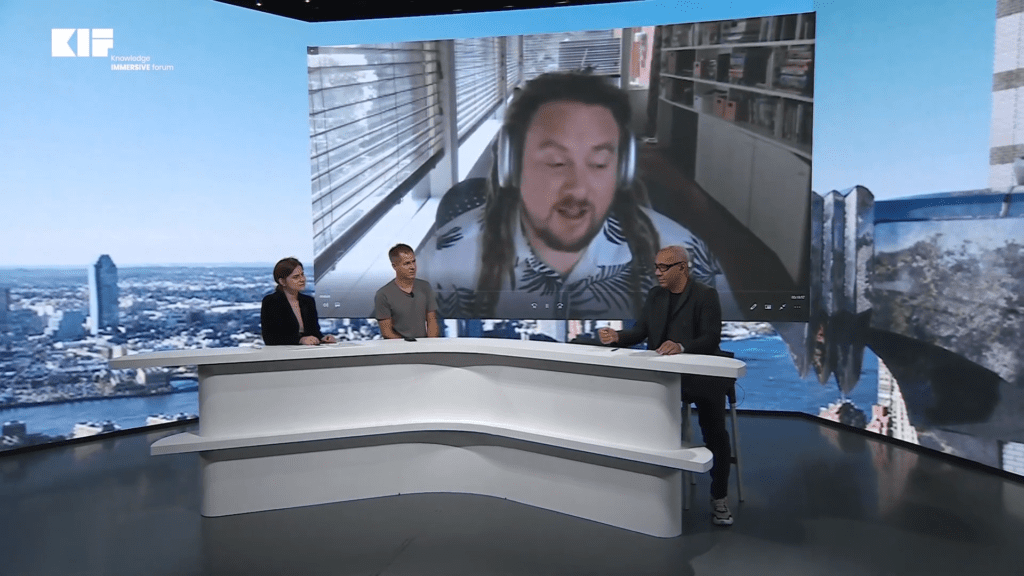
On peut utiliser l’image qui est derrière nous. Maintenant c’est couvert, mais l’image de la gargouille qui est derrière nous n’est pas une image fixe ou capturée. C’est une image qui se calcule en temps réel.

Alors quand la caméra sur son dolly bouge, on va voir que la gargouille derrière celle-là va apparaître. C’est-à-dire que la caméra est en train de tourner physiquement autour du Chrysler Building, d’accord ?

Donc ça c’est assez extraordinaire parce qu’on se rapproche de qualité photographique. Et ça n’est pas une image. C’est-à-dire, on est techniquement dans un jeu vidéo.

Ce qui est aussi très, très important, c’est que cet endroit que vous voyez là, qui est dans Garou, est accessible en réalité virtuelle de façon collaborative, c’est-à-dire que tous les gens qui sont dans la salle pourraient rentrer dans Garou et se mettre debout sur la gargouille.

Donc on peut décliner les usages à partir de ce jumeau numérique qui existe dans le moteur de jeu de plein de façons différentes.

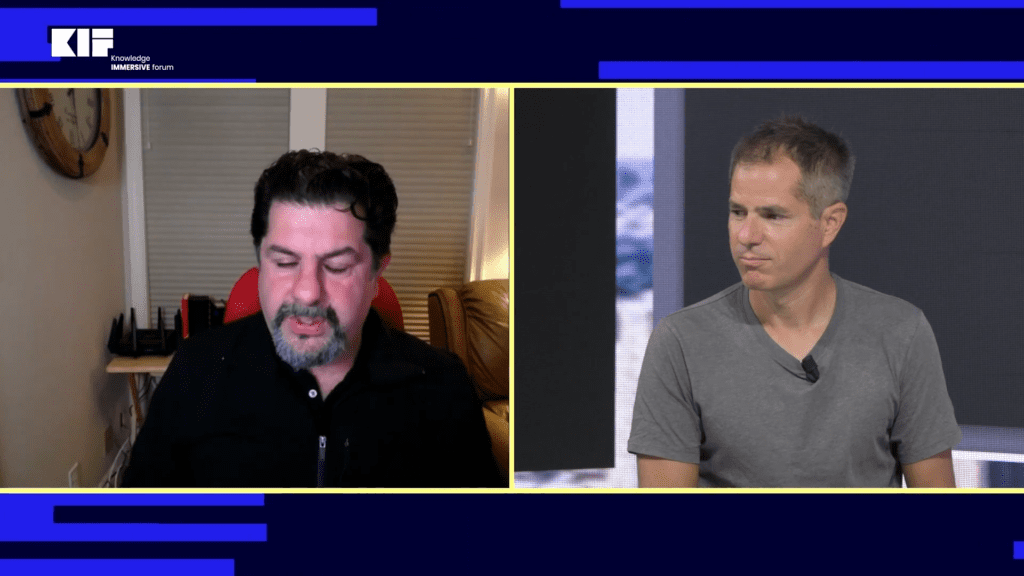
Alexandre Michelin : C’est extrêmement important et c’est ce qu’il faut avoir en tête. Tout ceci n’est que du calcul.

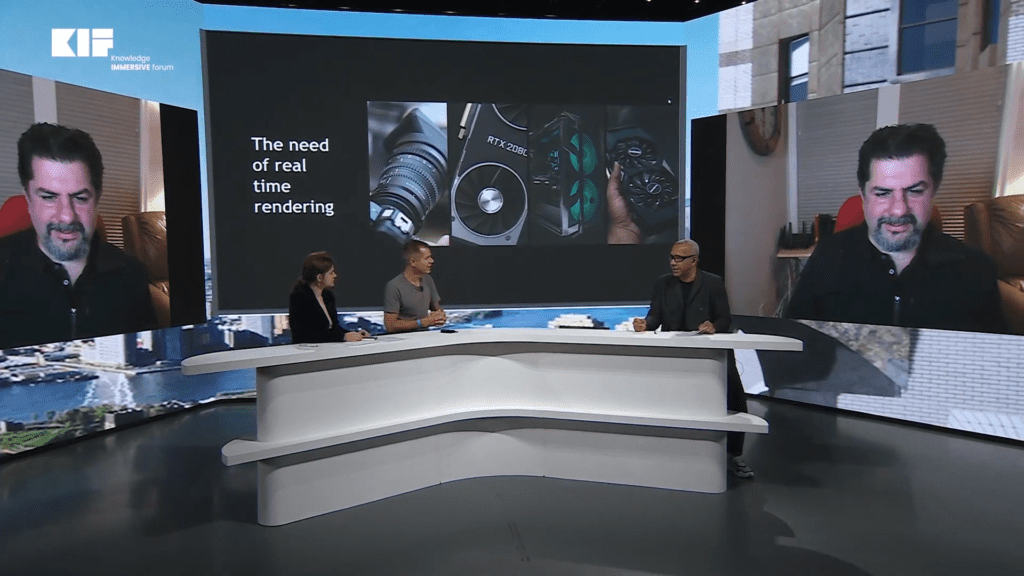
Gaspard Giroud : C’est ça. Et en ce moment, je suis à peu près certain, cette scène se calcule sur des cartes Nvidia, c’est-à-dire que cette réalité est construite pour nos yeux à la vitesse de 60, 90 images par seconde.

Le film à la télévision, c’était des images capturées qui étaient de 24 à 30 images par seconde. Le jeu vidéo, c’est 60 images par seconde d’images qui sont calculées en temps réel et la réalité virtuelle, c’est 90 images par seconde qui sont calculées en temps réel.

Dans les slides, si on peut les remettre, si on peut les ramener, je vais vous parler très rapidement de… voilà. Alors les images qu’on voit là, ça, c’est dans Garou. C’est-à-dire que c’est à la fois des images 2D qu’on peut utiliser pour de la communication, mais on peut aller aussi se balader physiquement dedans de façon collaborative.

Je vais avancer encore un petit peu. Alors ça, c’est le Unreal Engine 5. On se rend compte que, comme disait Marc Petit hier, on se rapproche d’une qualité photographique. On arrive pratiquement à créer des humains qui sont “believable”, comme on pourrait dire en anglais.

Présentateur : Alexandre Michelin

Intervenants :

  • Clara Schmelck (philosophe, journaliste, prof à Sciences Po Strasbourg)
  • Gaspard Giroud (Fondateur et CEO de Garou)
  • Rev Labaredian (Vice Président de NVIDIA)
  • Bertrand Nepveu (Fondateur de Vrvana)
Rev Labaredian : Les éléments essentiels à la construction du métaverse

[kif_post_tags]

Rev Labaredian : If you look at what is involved in creating a video game and what a modern video game is today, a 3D video game, it’s essentially a simulation of a whole other world.

We’re creating these worlds that look beautiful, that look closer and closer to our reality. Things inside the world behave correctly. We simulate the physics inside these worlds.

So when things interact with each other, it looks correct and behaves correct. And we also fill these worlds with intelligences, with other beings, AIs.

So all of these things combined are the ingredients that you need to construct another virtual world, what we’re now starting to call the metaverse more commonly.

In order to do the world justice, to do it at the fidelity and the quality and the accuracy that we really want as humans, you need an amazing, an awesome amount of compute.

We still aren’t quite there yet. You can use every, every bit of compute on the Earth that’s available right now, you could dedicate it to doing a simulation of the world, and it’s still not enough. So we need to continue to keep building this.

The start of 3D video gaming in the nineties coincided with when we started in video. We built these special processors, these chips designed to accelerate the rendering portion of this problem. And what rendering is, it’s a simulation of the physics of how light interacts with matter.

That’s what we used to create the images. Years later, we made our processors more general so we can program them not just to do the physics of light, but to do physics in general.

And next step after that, since we made our processors, these powerful computing machines that were available to everyone who wants to build a PC to play video games, we made them so programmable that deep learning and artificial intelligence became possible. It was born on top of our processors on the computing processors that we made available.

Combining our computing with the information that’s available on the internet, all of the data that’s available there with new algorithms has given birth to this AI thing.

And so now we are in this new era where we can simulate and create every part of these virtual worlds, and that’s converging with the amazing amount of data and the connectivity that everyone experiences on the internet.

And we’re entering a new phase. The next step, the evolution of the internet into what we were all dreaming about, or many of us were, as the metaverse, starting back in the 80s and 90s.

Gaspard Giroud : Thank you so much Rev. We’re going to do a little bit of translation for our French or French audience.

Rev Labaredian : I can try to keep it shorter next time.

Gaspard Giroud : Thank you. No, this is great. We enjoyed every second of your time.

Alexandre Michelin : En fait, il faut bien comprendre qu’il y a une convergence, il y a plusieurs convergences. Il y en a une qui est sur les microchips, qui permet la puissance de calcul de plus en plus grande. Il y a une convergence sur la capacité informatique, de codage, capacité de traiter des données de très, très haute qualité, volume, enfin tout ce qu’on peut avoir.

C’est ce qui permet ce passage de choses qui sont finalement simples. Des choses de plus en plus complexes, avec des polygones ou des choses comme celles que fait Garou. On est dans presque le réalisme photo dont parlait hier Marc Petit.

Et c’est l’objectif. Et c’est pour ça que cette vision est extrêmement puissante. Elle est convergente avec ce qui se passe à l’intérieur des machines. Elle est convergente avec la capacité de traitement, l’intelligence artificielle, les algorithmes qui permettent de traiter une multiplicité de données de manière simultanée, de la modéliser en petits polygones.

Et c’est chacun de ces éléments qui fabriquent ces photos, ces éléments ; on ne sait plus comment les qualifier.

Des formules mathématiques, qui sont en fait des images pour notre cerveau. C’est là où on est dans la matrice. Sans le savoir, tout ce qui nous entoure là ne sont que des calculs mathématiques, ce ne sont que des zéros et des uns.

Présentateur : Alexandre Michelin

Intervenants :

  • Clara Schmelck (philosophe, journaliste, prof à Sciences Po Strasbourg)
  • Gaspard Giroud (Fondateur et CEO de Garou)
  • Rev Labaredian (Vice Président de NVIDIA)
  • Bertrand Nepveu (Fondateur de Vrvana)
La France a toutes les clés pour prendre part à la construction du métaverse

[kif_post_tags]

Gaspard Giroud : Je pense que les gens, encore une fois, j’allais dire pour une dernière fois je pense que la France doit se réveiller. Il faut aller visiter ce territoire avant qu’il soit trop tard et qu’on se retourne et que ça a été fait, justement, sans nous.

Clara Schmelck : Surtout qu’il y a des talents, il y a les infrastructures, il y a tout ce qu’il faut.

Gaspard Giroud : Exactement. Je veux dire, Ubisoft, des sociétés comme ça. Les Français sont très forts en éducation, effets spéciaux et gaming. Tout est là.

Alexandre Michelin : On y va. Merci beaucoup.

Gaspard Giroud : Merci.

Présentateur : Alexandre Michelin

Intervenants :

  • Clara Schmelck (philosophe, journaliste, prof à Sciences Po Strasbourg)
  • Gaspard Giroud (Fondateur et CEO de Garou)
  • Rev Labaredian (Vice Président de NVIDIA)
  • Bertrand Nepveu (Fondateur de VRvana)

Quelles bases pour construire un métaverse fonctionnel, positif et pérenne ?

[kif_post_tags]

Rev Labaredian : When the internet was first conceived – and it was built starting in the 70s – the original pioneers, the ones that founded it and laid down the foundation of all the protocols and the standards, really believed that everyone that’s connected to the internet should be equal. That every server, every person, every workstation that’s connected can both serve and receive.

Yeah, it can go in both directions. Years later, when the web was formed, it was built on that technology, but also that philosophy. The central technology to the World Wide Web, html, http, all of these standards that we take for granted right now, were built around this idea that everybody can contribute and everybody has an equal access to building their piece of it.

And as a result, we’ve gone from the internet and the web in the early 90s being, you know, relatively niche thing that only some government agencies and universities had access to, to it being a part of our life everywhere in the world, billions of people are on it.

We need to do the same for the metaverse. If we build a metaverse without open standards, without giving everybody access to contribute to it, then it’s not going to be, it could be a pretty dangerous experience actually for most people.

What we really need to do this time is have governments, have the public sector and everybody involved in building this and carve out spaces that are open to the public. Even more so now because it’s not just text and 2D pages, we’re actually going to have the equivalent of spaces like we do in this reality, inside the virtual world. And in those spaces, we’re going to need things like parks and libraries, all the things that we all love and enjoy from our public common spaces with each other.

It’s critical that we all participate, not just have a few islands of information.

Alexandre Michelin : Thank you, Rev; thank you so much. Thank you so much for waking up so early and to join us.

Je vais synthétiser. C’est un peu le même message que celui que transmettait Marc hier. Et c’est intéressant que deux des plus grandes boîtes le partagent. C’est-à-dire qu’on ne peut pas construire ça tout seul.

Deuxièmement, il y a des risques réels. On n’est pas naïfs. On sait ce que ça représente, s’il y a un métaverse c’est une dictature, en plus par l’imaginaire et le visuel et l’émotionnel…

Clara Schmelck : Et qui incorpore en quelque sorte, qui prend vraiment tout le corps.

Alexandre Michelin : Voilà, qui prend tout le corps.

Gaspard Giroud : C’est ça. On est complètement engagés physiquement dedans, donc…

Alexandre Michelin : Voilà. Ce qu’on a compris de la première révolution de l’internet, on doit essayer d’en tirer des leçons aujourd’hui ?

Gaspard Giroud : Je pense que c’est particulièrement intéressant, par exemple pour les gens qui sont des parents, d’imaginer que leurs enfants vont grandir là-dedans.

Alors effectivement, est-ce qu’on préfère que monde diversifié, qu’il n’y ait pas qu’une seule société qui en soit propriétaire, comment est-ce qu’on construit ensemble.

Je pense que Nvidia comme Epic Games n’arrêtent pas de tendre les mains un petit peu à tout le monde pour dire : “écoutez, essayons de faire ça le mieux possible.”

Présentateur : Alexandre Michelin

Intervenants :

  • Clara Schmelck (philosophe, journaliste, prof à Sciences Po Strasbourg)
  • Gaspard Giroud (Fondateur et CEO de Garou)
  • Rev Labaredian (Vice Président de NVIDIA)
  • Bertrand Nepveu (Fondateur de VRvana)

Interview de Bertand Nepveu, créateur du casque de réalité virtuel racheté par Apple

[kif_post_tags]

Gaspard Giroud : I admire Bertrand, because he’s an absolutely incredible engineer that I met in Los Angeles four years ago, and he had built a headset.

Il avait construit un casque qui était virtual reality and augmented reality, both.

And what happened is that when I saw it, I was very impressed. I was incredible and it was very, very early. He had done it by himself. And then a year later, Apple bought his company, VRvana.

And so he’s a core engineer. He’s the guy who literally built it. So I thought it would be amazing to have him and talk about the headsets.

Alexandre Michelin : Oui, donc dans cette transformation, les étapes du métaverse, il y a effectivement la question des devices, et l’histoire de Bertrand Nepveu est assez exceptionnelle. C’est un vrai geek, un “core engineer”, comme tu as dis, qui a travaillé et développé le casque tout seul, le sien.

Tout le monde se pose la question de ce que va faire Apple. Il n’a pas le droit de dire ce que va faire Apple.

Gaspard Giroud : Il ne mentionne même pas Apple.

Alexandre Michelin : Mais il faut savoir que sa société a été achetée pour plusieurs dizaines de millions de dollars par Apple, assez discrètement. Et il a accepté de parler. On va écouter son interview puis on reviendra dessus avec toi et Rev.

Bertrand Nepveu : Thanks Gaspard for the invitation. My name is Bertrand Nepveu. I’m an engineer and started a company called VRvana in 2005.

Why start a company in 2005 ? Well, I mean, I was a hardcore gamer since, like the ColecoVision and Nintendo and the power level and all that stuff since a very young age. I wanted to be inside the games that I love so much instead of just playing on the screen.

So in 2005, that’s when we started the VRvana adventure. So we went from a VR headset for X-Box up to a mixed reality headset where you can switch from VR to AR on the same device.

Gaspard Giroud : Pour les gens qui s’intéressent à notre industrie, il a commencé très, très, très tôt, juste parce qu’il voulait rentrer dans les jeux vidéo.

Bertrand Nepveu : You’re going to feel like you’re there and not just like through a screen. And one really cool experience that I did lately was… so I used to go physically at Burning Man for the past few years. And of course, because of the pandemic, you know, they canceled it.

But they did an out space VR, a virtual burning man. And it was a really interesting experience for me because I think the first day I just tried it on my computer and I was like : “Oh yeah, I feel like, I see the same things as when I’m there, you know, and it was kind of cool.

But when the next day I tried it in VR, it was a totally different experience because, you know, the art pieces are very big there, but on the screen you don’t really feel the scale.

Gaspard Giroud : Donc ce qu’il dit très, très clairement, c’est la différence entre faire l’expérience de quelque chose en 2D ou en réalité virtuelle.

Alexandre Michelin : Et il mentionne Burning Man.

Bertrand Nepveu : … that’s what makes VR magical. Right now, it’s the only medium that can do that.

So once people experience the value of that, of course, they will always want to do it in VR instead that on the TV screen. But for that, you need more and more people trying it. And I think that we’re seeing the mass adoption of VR right now.

Alexandre Michelin : Donc les grandes étapes pour l’adoption.

Bertrand Nepveu : Convenience needs to be the number 1 thing. I’m an expert in VR and like, if I want to go and try a new game and it’s on Steam, on the PC, like with device… they will work but not seamlessly.

If I haven’t played a game for, I don’t know, a couple weeks and I go and there’s an update and it takes always maybe 30 minutes…

Gaspard Giroud : Voilà donc son premier sujet c’est : “il faut que ce soit facile.” Il ne faut pas qu’il y ait des barrières pour rentrer dans l’espace VR.

Bertrand Nepveu : …and I think I solved that. You know, each time I go back, I put the Quest, it works, you know, it updates automatically…

Alexandre Michelin : On comprend pourquoi Apple l’a racheté. Il a déjà la philosophie…

Bertrand Nepveu : I think that for mass adoption it’s always practice. I think because of Hollywood movies…

Gaspard Giroud : Ça je suis d’accord avec lui, c’est très important. Les gens sont tellement habitués à de la qualité, qualité graphique du cinéma, des effets spéciaux, etc. Et il dit : “c’est ça à quoi les gens sont habitués, donc il faut qu’on arrive là.”

Bertrand Nepveu : If you have someone who is not a geek and who wants to travel or whatever, if you put the headset and it feels not natural, then they might say “oh, all the way.”

So I think now that the mobile part is kind of done, you know, the tracking, the wires all that. I think that, like you said, the graphics need to be maybe two or three times better.

But to get there, you can either like go brute force and just have a bigger GPU. But, I mean, that means maybe three or four years.

But the great thing about a VR headset is that what you’re doing is you’re messing with the brain. You’re trying to fool the brain…

Alexandre Michelin : On essaye de transformer, de manipuler, to “fool the brain”, de retourner.

Bertrand Nepveu : So the more we learn about, and we already know a lot, but the more we learn how the brain process, all those stimulations…

Alexandre Michelin : Et on pense aussi que c’est pas que dans le casque, finalement. Ca fera partie des lunettes… grâce à la 5G.

Bertrand Nepveu : …and that requires a lot of power to do some little brain tricks to reduce the compute and still deliver an amazing graphical experience.

Gaspard Giroud : Alors ça c’est très technique, c’est un peu compliqué. C’est que les casques les plus avancés ne font du réalisme que exactement dans un cône de vision des pupilles, et la zone périphérique autour de ça est calculée en résolution moindre. Le cerveau ne s’en rend pas compte, c’est normal, mais ça permet d’augmenter énormément la qualité.

C’est pour les lunettes. 100% pour les lunettes.

Bertrand Nepveu : …you compute everything in the cloud…

Gaspard Giroud : C’est une solution technique pour pouvoir augmenter nettement la qualité avec la même puissance de calcul.

Bertrand Nepveu : …that are being built that will enable a mass adoption of the metaverse and VR.

Great question. I think that people tend to think that to solve new problems, you need to throw tons of resources on it. And we have a little history about that, is flying, you know. There was a race to do the first planes…

Alexandre Michelin : L’analogie est assez forte. Il compare la course au casque avec la course à l’aviation. Ce n’est pas forcément le maximum de ressources qui gagne.

Gaspard Giroud : Exactement. Et c’est très, très inspirant pour les gens, y compris pour Garou et d’autres associés comme ça, et c’était son cas à lui, il parle d’expérience. C’est-à-dire que ce n’est pas la quantité d’argent… pas que. Pas au début.

Clara Schmelck : En attendant on voit bien qu’il s’agit d’une vraie révolution industrielle.

Bertrand Nepveu : If you go back, it had the best Nvidia graphics on the planet way back in 2005. Now that’s a bit different, but way back like they were pushing for that. So that was kind of like : “OK, now we have like the building blocks to try to do this, but it took us like, to really have something that we could be proud of, you know, it took like, I don’t know, 10 years.

Alexandre Michelin : 10 ans de boulot.

Gaspard Giroud : 10 ans pour être content du premier casque.

Bertrand Nepveu : From 2005 to 2015, you know. It was trial and error and lots of failures, but we were a very small team, we were like four people for so long and almost no salary, so there was no pressure to deliver something.

If you work at a big company like Magic Leap or whatever…

Alexandre Michelin : Il parle des concurrents qui avaient des moyens considérables.

Bertrand Nepveu : As for us, it was like : “OK, we need to find the right technology.” And then it took ten years, but then, when the blocks were there, we grew the team to about a dozen, like top of the line engineer. I found that it’s better to have one really great engineer than five average. You know, they’re not bad, but one really great engineer will decuplate the creativity, how you connect…

It was a bit like you know, when they started Apple, Steve Jobs and Wozniak. You know Wozniak…

Alexandre Michelin : C’est vrai qu’il fait mention à Wozniak, on sent la même vibe.

Bertrand Nepveu : …it’s not all the way like brute force. It is way a clever way to connect. Maybe the chips are not meant for that. VR was a bit like that at the beginning. It was : “let’s take parts, that our first cell phones, that the Wii controler, or whatever, and put them together in a clever way to show the potential and be great.

So I think that was what we did. Great is like take the best parts and put them together in a clever way. But then after that, you know, you need to scale things.

Alexandre Michelin : Le passage à l’échelle, c’est le point-clé. Il ne s’agit pas simplement de faire un truc cool, sympa. Le vrai test c’est quand ça peut grandir.

Gaspard Giroud : Lui il l’a amené jusqu’à ce que ça puisse aller en production de masse. Et ensuite, il est parti chez un gros tech player.

Bertrand Nepveu : …I think now there’s three or four millions of that. So that’s an amazing achievement from Facebook…

Alexandre Michelin : Il est resté plusieurs années chez Apple ?

Gaspard Giroud : Quatre ans, presque quatre ans chez Apple.

Bertrand Nepveu : …you know, I tell them like “buy this”, they try it, they love it. It makes it very simple. But to simplify something great, it takes a lot, a lot of work and engineering. Something that we couldn’t have done as a small team, but at least we showed that it was possible to mix AR and VR in the same headset.

Gaspard Giroud : Ce qui est important, c’est que, effectivement, Bertrand, en 2007, après avoir commencé en 2005, avait créé un casque qui pouvait switcher entre VR et AR.

Et ce qui est fascinant c’est de voir que, comme il disait en fait, ce n’est pas toujours “brute force”, c’est-à-dire ce n’est pas les millions que tu investis dedans, c’est vraiment d’être “clever”.

Magic Leap sont toujours avec 1 milliard plus d’investissements et sont toujours en train de le faire.

Alexandre Michelin : Oui, et lui il dit “to simplify”, pour simplifier quelque chose de complexe, c’est pas forcément la puissance qui gagne. C’est le talent, en fait.

Gaspard Giroud : C’est pour ça que je l’admire énormément.

Alexandre Michelin : On en a aussi parlé pendant tous les jours, il n’y a que le talent qui fait la différence. La technologie peut peut-être l’augmenter, mais c’est que le talent des artistes ou des ingénieurs…

Gaspard Giroud : Jusqu’à un point. Comme il disait, après à partir de cinq, pour le passage à l’échelle…

Clara Schmelck : Il faut une infrastructure.

Présentateur : Alexandre Michelin

Intervenants :

  • Clara Schmelck (philosophe, journaliste, prof à Sciences Po Strasbourg)
  • Gaspard Giroud (Fondateur et CEO de Garou)
  • Rev Labaredian (Vice Président de NVIDIA)
  • Bertrand Nepveu (Fondateur de VRvana)

Le métaverse, sommes-nous à l’aube d’une révolution technologique et industrielle ? (2)

[kif_post_tags]

Rev Labaredian : We are very well known for building chips and processors that power a lot of this computing. But we are much more than just just a hardware company. From the very beginning, we developed lots of software that are in layers, that empower developers to create the experiences, create video games and tools to create these virtual worlds.

In recent years, we’ve started to do a lot of simulation for things that aren’t gaming or entertainment related. We do simulation for robotics and for autonomous vehicles. We’re creating these worlds to train, to give birth, to and allow these artificial intelligences to learn and become better before we put them in the real world.

And in order to do that, we need to have worlds that are extremely, extremely accurate. We want to drive our self-driving cars for billions of miles in the virtual world, well before we take the brain from inside this virtual world and put it in a real car in the real street.

So we built Omniverse to be this scalable simulation engine that can scale to the supercomputers that we’ve been building for many other applications outside of video games.

In addition, we believe that the metaverse is going to be much larger than the World Wide Web and the internet is. I think if you were to go back 20, 30 years to the early days of the internet or right when the World Wide Web appeared in 1993, most people would not have guessed that it would be as big as it is today.

But we believe that the metaverse is going to be much bigger than that. We can’t even imagine what that is. In order for it to get to that size, we need everybody to contribute to building the metaverse, the same way we built the web, where everybody could contribute to building web pages.

We need everybody to construct these worlds, their piece of the metaverse. So we’re building Omniverse to help simulate this scale. Also connect up all of the tools, all of the techniques and everything available in every industry, so we can all contribute to building one big metaverse that’s open to all.

Gaspard Giroud : Thank you so much. We’re going to have a little translation.

Alexandre Michelin : Beaucoup d’idées très fortes qui convergent aussi avec celles qu’on a partagées avec Marc Petit hier. Donc, une révolution technologique dans les microchips, des super programmes avec des super ordinateurs qui permettent de gérer en temps réel des données ultra présentes, et la nécessité d’être ouverts pour que, comme l’internet l’a fait, on soit en face d’une diffusion massive.

Et l’option d’Omniverse, c’est de penser que ce sera plus grand que l’internet, que ce sera plus grand que le téléphone mobile et que c’est une transformation qu’on a peine à imaginer et qu’on ne peut pas imaginer, comme certains penseraient, en étant seul.

On est obligé de collaborer. C’est aussi une idée qui était transverse dans toutes les discussions, que ce soit les artistes, que ce soit les industriels. On ne peut pas arriver à ce niveau de complexité en pensant qu’on va y arriver tout seul.

Gaspard Giroud : Non, ça c’est tout à fait vrai. En plus, je pense qu’il y a quand même un aspect philosophique et politique. Très souvent, la science-fiction a projeté des images d’industriels qui prenaient le monde. C’est le cas dans Ready Player One.

C’est un peu David et Goliath. C’est aussi quand on voit Tyrell Corporation dans Blade Runner… c’est assez facile d’imaginer que s’il y a un métaverse, il faut qu’il soit partagé.

Mais effectivement, en fait ce que disait Marc Petit, et aussi ce que dit Rev, bien sûr il faut que ce soit collaboratif, mais en fait c’est tellement énorme que Marc Petit disait hier “je ne peux pas mettre de numéro en face sur l’opportunité économique, ça n’a pas de sens”.

Rev dit : “this is so big, like we need to work all together.”,

Alexandre Michelin : Tout ça, c’est un point extrêmement important. On voit que les sociétés qui sont là-dessus, du côté américain, c’est les plus grandes sociétés du monde. Facebook, 1 800$ de valorisation boursière, Microsoft de 2 200$, Apple 2 300 milliards de dollars, et Nvidia je connais pas la valorisation boursière.

On voit que ce n’est pas du tout un rêve de start uppers, non, c’est les plus grandes entreprises qui sont en train de préparer quelque chose qui est extrêmement massif.

Sans compter les États comme la Chine, qui travaillent aussi de manière hyperactive, comme dans l’informatique quantique et dans d’autres. Donc, c’est vraiment une révolution industrielle.

Présentateur : Alexandre Michelin

Intervenants :

  • Clara Schmelck (philosophe, journaliste, prof à Sciences Po Strasbourg)
  • Gaspard Giroud (Fondateur et CEO de Garou)
  • Rev Labaredian (Vice Président de NVIDIA)
  • Bertrand Nepveu (Fondateur de Vrvana)
Le métaverse, sommes-nous à l’aube d’une révolution technologique et industrielle ?

[kif_post_tags]

Rev Labaredian : We are very well known for building chips and processors that power a lot of this computing. But we are much more than just just a hardware company. From the very beginning, we developed lots of software that are in layers, that empower developers to create the experiences, create video games and tools to create these virtual worlds.

In recent years, we’ve started to do a lot of simulation for things that aren’t gaming or entertainment related. We do simulation for robotics and for autonomous vehicles. We’re creating these worlds to train, to give birth, to and allow these artificial intelligences to learn and become better before we put them in the real world.

And in order to do that, we need to have worlds that are extremely, extremely accurate. We want to drive our self-driving cars for billions of miles in the virtual world, well before we take the brain from inside this virtual world and put it in a real car in the real street.

So we built Omniverse to be this scalable simulation engine that can scale to the supercomputers that we’ve been building for many other applications outside of video games.

In addition, we believe that the metaverse is going to be much larger than the World Wide Web and the internet is. I think if you were to go back 20, 30 years to the early days of the internet or right when the World Wide Web appeared in 1993, most people would not have guessed that it would be as big as it is today.

But we believe that the metaverse is going to be much bigger than that. We can’t even imagine what that is. In order for it to get to that size, we need everybody to contribute to building the metaverse, the same way we built the web, where everybody could contribute to building web pages.

We need everybody to construct these worlds, their piece of the metaverse. So we’re building Omniverse to help simulate this scale. Also connect up all of the tools, all of the techniques and everything available in every industry, so we can all contribute to building one big metaverse that’s open to all.

Gaspard Giroud : Thank you so much. We’re going to have a little translation.

Alexandre Michelin : Beaucoup d’idées très fortes qui convergent aussi avec celles qu’on a partagées avec Marc Petit hier. Donc, une révolution technologique dans les microchips, des super programmes avec des super ordinateurs qui permettent de gérer en temps réel des données ultra présentes, et la nécessité d’être ouverts pour que, comme l’internet l’a fait, on soit en face d’une diffusion massive.

Et l’option d’Omniverse, c’est de penser que ce sera plus grand que l’internet, que ce sera plus grand que le téléphone mobile et que c’est une transformation qu’on a peine à imaginer et qu’on ne peut pas imaginer, comme certains penseraient, en étant seul.

On est obligé de collaborer. C’est aussi une idée qui était transverse dans toutes les discussions, que ce soit les artistes, que ce soit les industriels. On ne peut pas arriver à ce niveau de complexité en pensant qu’on va y arriver tout seul.

Gaspard Giroud : Non, ça c’est tout à fait vrai. En plus, je pense qu’il y a quand même un aspect philosophique et politique. Très souvent, la science-fiction a projeté des images d’industriels qui prenaient le monde. C’est le cas dans Ready Player One.

C’est un peu David et Goliath. C’est aussi quand on voit Tyrell Corporation dans Blade Runner… c’est assez facile d’imaginer que s’il y a un métaverse, il faut qu’il soit partagé.

Mais effectivement, en fait ce que disait Marc Petit, et aussi ce que dit Rev, bien sûr il faut que ce soit collaboratif, mais en fait c’est tellement énorme que Marc Petit disait hier “je ne peux pas mettre de numéro en face sur l’opportunité économique, ça n’a pas de sens”.

Rev dit : “this is so big, like we need to work all together.”,

Alexandre Michelin : Tout ça, c’est un point extrêmement important. On voit que les sociétés qui sont là-dessus, du côté américain, c’est les plus grandes sociétés du monde. Facebook, 1 800$ de valorisation boursière, Microsoft de 2 200$, Apple 2 300 milliards de dollars, et Nvidia je connais pas la valorisation boursière.

On voit que ce n’est pas du tout un rêve de start uppers, non, c’est les plus grandes entreprises qui sont en train de préparer quelque chose qui est extrêmement massif.

Sans compter les États comme la Chine, qui travaillent aussi de manière hyperactive, comme dans l’informatique quantique et dans d’autres. Donc, c’est vraiment une révolution industrielle.

Présentateur : Alexandre Michelin

Intervenants :

  • Clara Schmelck (philosophe, journaliste, prof à Sciences Po Strasbourg)
  • Gaspard Giroud (Fondateur et CEO de Garou)
  • Rev Labaredian (Vice Président de NVIDIA)
  • Bertrand Nepveu (Fondateur de Vrvana)
Gaspard Giroud : Comment fonctionne la 3D en temps réel ?

[kif_post_tags]

Gaspard Giroud : Je voulais qu’on parle un tout petit peu de technique pour comprendre vraiment quelle est la différence entre une simulation sur un moteur de jeu par rapport aux médias traditionnels qu’on connaît en 2D ?

On peut utiliser l’image qui est derrière nous. Maintenant c’est couvert, mais l’image de la gargouille qui est derrière nous n’est pas une image fixe ou capturée. C’est une image qui se calcule en temps réel.

Alors quand la caméra sur son dolly bouge, on va voir que la gargouille derrière celle-là va apparaître. C’est-à-dire que la caméra est en train de tourner physiquement autour du Chrysler Building, d’accord ?

Donc ça c’est assez extraordinaire parce qu’on se rapproche de qualité photographique. Et ça n’est pas une image. C’est-à-dire, on est techniquement dans un jeu vidéo.

Ce qui est aussi très, très important, c’est que cet endroit que vous voyez là, qui est dans Garou, est accessible en réalité virtuelle de façon collaborative, c’est-à-dire que tous les gens qui sont dans la salle pourraient rentrer dans Garou et se mettre debout sur la gargouille.

Donc on peut décliner les usages à partir de ce jumeau numérique qui existe dans le moteur de jeu de plein de façons différentes.

Alexandre Michelin : C’est extrêmement important et c’est ce qu’il faut avoir en tête. Tout ceci n’est que du calcul.

Gaspard Giroud : C’est ça. Et en ce moment, je suis à peu près certain, cette scène se calcule sur des cartes Nvidia, c’est-à-dire que cette réalité est construite pour nos yeux à la vitesse de 60, 90 images par seconde.

Le film à la télévision, c’était des images capturées qui étaient de 24 à 30 images par seconde. Le jeu vidéo, c’est 60 images par seconde d’images qui sont calculées en temps réel et la réalité virtuelle, c’est 90 images par seconde qui sont calculées en temps réel.

Dans les slides, si on peut les remettre, si on peut les ramener, je vais vous parler très rapidement de… voilà. Alors les images qu’on voit là, ça, c’est dans Garou. C’est-à-dire que c’est à la fois des images 2D qu’on peut utiliser pour de la communication, mais on peut aller aussi se balader physiquement dedans de façon collaborative.

Je vais avancer encore un petit peu. Alors ça, c’est le Unreal Engine 5. On se rend compte que, comme disait Marc Petit hier, on se rapproche d’une qualité photographique. On arrive pratiquement à créer des humains qui sont “believable”, comme on pourrait dire en anglais.

Présentateur : Alexandre Michelin

Intervenants :

  • Clara Schmelck (philosophe, journaliste, prof à Sciences Po Strasbourg)
  • Gaspard Giroud (Fondateur et CEO de Garou)
  • Rev Labaredian (Vice Président de NVIDIA)
  • Bertrand Nepveu (Fondateur de Vrvana)
Rev Labaredian : Les éléments essentiels à la construction du métaverse

[kif_post_tags]

Rev Labaredian : If you look at what is involved in creating a video game and what a modern video game is today, a 3D video game, it’s essentially a simulation of a whole other world.

We’re creating these worlds that look beautiful, that look closer and closer to our reality. Things inside the world behave correctly. We simulate the physics inside these worlds.

So when things interact with each other, it looks correct and behaves correct. And we also fill these worlds with intelligences, with other beings, AIs.

So all of these things combined are the ingredients that you need to construct another virtual world, what we’re now starting to call the metaverse more commonly.

In order to do the world justice, to do it at the fidelity and the quality and the accuracy that we really want as humans, you need an amazing, an awesome amount of compute.

We still aren’t quite there yet. You can use every, every bit of compute on the Earth that’s available right now, you could dedicate it to doing a simulation of the world, and it’s still not enough. So we need to continue to keep building this.

The start of 3D video gaming in the nineties coincided with when we started in video. We built these special processors, these chips designed to accelerate the rendering portion of this problem. And what rendering is, it’s a simulation of the physics of how light interacts with matter.

That’s what we used to create the images. Years later, we made our processors more general so we can program them not just to do the physics of light, but to do physics in general.

And next step after that, since we made our processors, these powerful computing machines that were available to everyone who wants to build a PC to play video games, we made them so programmable that deep learning and artificial intelligence became possible. It was born on top of our processors on the computing processors that we made available.

Combining our computing with the information that’s available on the internet, all of the data that’s available there with new algorithms has given birth to this AI thing.

And so now we are in this new era where we can simulate and create every part of these virtual worlds, and that’s converging with the amazing amount of data and the connectivity that everyone experiences on the internet.

And we’re entering a new phase. The next step, the evolution of the internet into what we were all dreaming about, or many of us were, as the metaverse, starting back in the 80s and 90s.

Gaspard Giroud : Thank you so much Rev. We’re going to do a little bit of translation for our French or French audience.

Rev Labaredian : I can try to keep it shorter next time.

Gaspard Giroud : Thank you. No, this is great. We enjoyed every second of your time.

Alexandre Michelin : En fait, il faut bien comprendre qu’il y a une convergence, il y a plusieurs convergences. Il y en a une qui est sur les microchips, qui permet la puissance de calcul de plus en plus grande. Il y a une convergence sur la capacité informatique, de codage, capacité de traiter des données de très, très haute qualité, volume, enfin tout ce qu’on peut avoir.

C’est ce qui permet ce passage de choses qui sont finalement simples. Des choses de plus en plus complexes, avec des polygones ou des choses comme celles que fait Garou. On est dans presque le réalisme photo dont parlait hier Marc Petit.

Et c’est l’objectif. Et c’est pour ça que cette vision est extrêmement puissante. Elle est convergente avec ce qui se passe à l’intérieur des machines. Elle est convergente avec la capacité de traitement, l’intelligence artificielle, les algorithmes qui permettent de traiter une multiplicité de données de manière simultanée, de la modéliser en petits polygones.

Et c’est chacun de ces éléments qui fabriquent ces photos, ces éléments ; on ne sait plus comment les qualifier.

Des formules mathématiques, qui sont en fait des images pour notre cerveau. C’est là où on est dans la matrice. Sans le savoir, tout ce qui nous entoure là ne sont que des calculs mathématiques, ce ne sont que des zéros et des uns.

Présentateur : Alexandre Michelin

Intervenants :

  • Clara Schmelck (philosophe, journaliste, prof à Sciences Po Strasbourg)
  • Gaspard Giroud (Fondateur et CEO de Garou)
  • Rev Labaredian (Vice Président de NVIDIA)
  • Bertrand Nepveu (Fondateur de Vrvana)
L’ère du métaverse, des mondes virtuels : pourquoi cela nous a-t-il pris autant de temps ?

[kif_post_tags]

Gaspard Giroud : In order to build the metaverse, I think we have to realize that it’s a convergence of technologies that are also coming ripe right now.

And it’s not that we didn’t want to build the metaverse in like in the 90s or in the early 2000s. It’s because we didn’t have the proper tools, not everything was built.

This is really where Rev should talk, but I would like to identify like a few pieces. One piece is the software piece, the game engines. The evolution of the game engines shows that we came closer and closer to rebuilding reality as we sit in the real world.

But it took a long time. So we’re going to very quickly go over this and Rev will be talking about that. And then there’s the hardware piece. The graphics card just did not compute this game in a very realistic way.

Again, this is Rev’s territory 100%. And then there’s the headset. As we talked about, if you are going into a metaverse or a virtual reality, I think the headsets are very important, and last thing is the network, the 5G network.

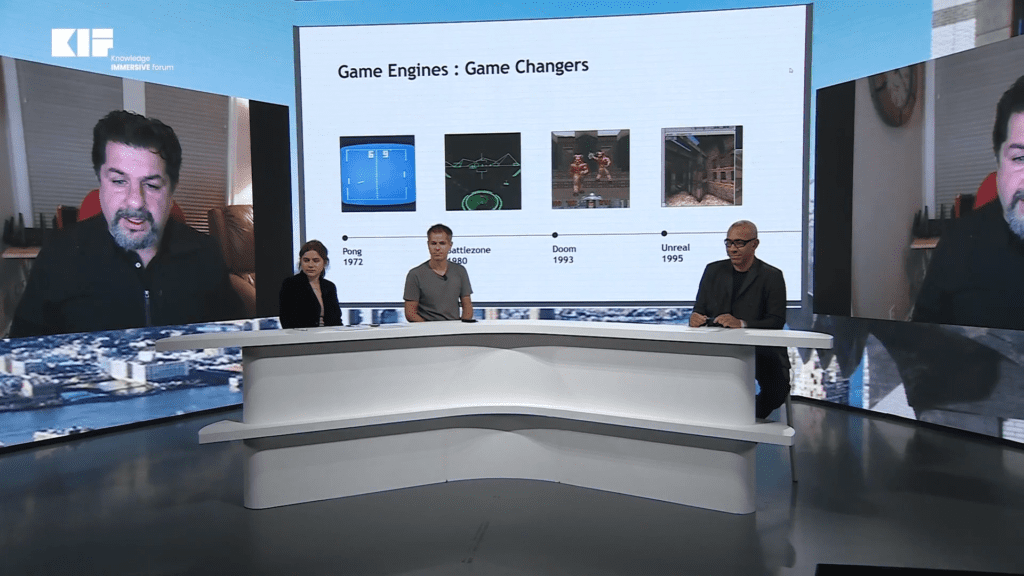
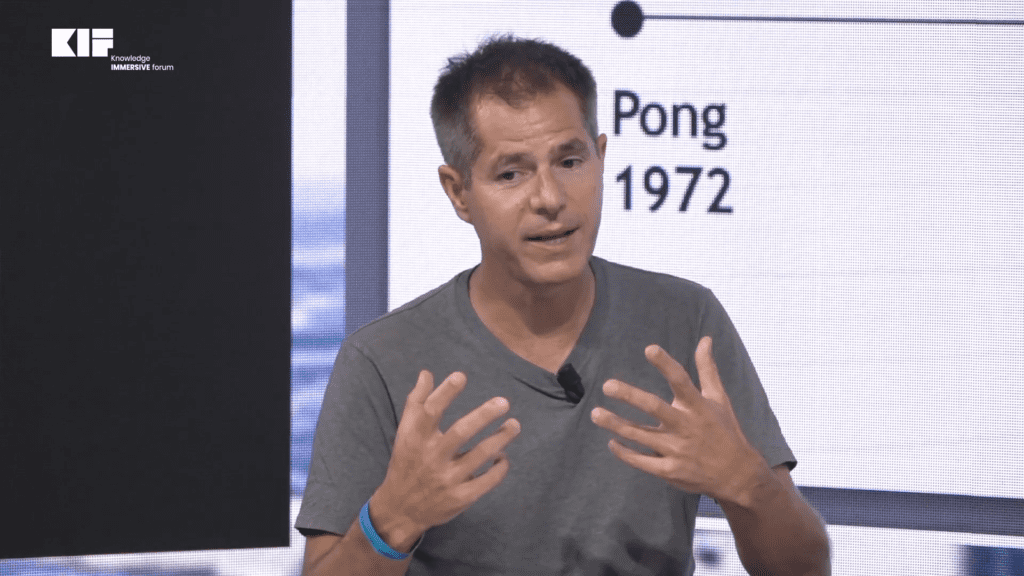
Alexandre Michelin : Je fais un peu de traduction simultanée. Élément essentiel, une des briques essentielles, ce sont les moteurs de jeu vidéo. On voit leur évolution, ils partent de Pong. Tout le monde a joué à Pong, comme dirait Sébastien, j’espère.

Et puis ensuite, c’est devenu de plus en plus sophistiqué, jusqu’à Unreal et d’autres, évidemment. Et on voit bien la progression de la représentation et de la visualisation qui devient de plus en plus sophistiquée. C’est ce que nous disait hier Marc Petit, et il y en a d’autres qui le font.

Et l’autre élément qui est très important, c’est les cartes graphiques. Et puis, le troisième élément, c’est le network. C’est la capacité de distribution.

Présentateur : Alexandre Michelin

Intervenants :

  • Clara Schmelck (philosophe, journaliste, prof à Sciences Po Strasbourg)
  • Gaspard Giroud (Fondateur et CEO de Garou)
  • Rev Labaredian (Vice Président de NVIDIA)
  • Bertrand Nepveu (Fondateur de Vrvana)
Langues »